Vintage Black and White People Drawing Box
 Coon Chicken InnCoon Craven Inn was a small restaurant chain in the American Due west from the late 1920s through the 1950s. The restaurants were known for their entrances, which featured the head of a winking, smile, grotesquely caricatured black man wearing a porter's cap. The words "Coon Chicken Inn" were written on teeth framed by oversized reddish lips. Visitors entered through a doorway in the middle of the black homo'south mouth. The menu included southern fried "Coon Chicken" sandwiches and chicken pie, besides as hamburgers, seafood, chili, and assorted sandwiches. Blacks (especially ones with very dark pare) were employed as waiters, waitresses, and cooks. | 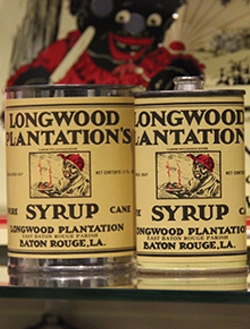 Racism In The KitchenDuring the Jim Crow period a typical American kitchen had many products with images that portrayed blacks in negative ways; these included packaging for cereal, syrup, pancake mix, and detergent; salt and pepper shakers; string holders; cookbooks; hand towels; placemats; grocery list reminders; and, wall hangings. Any object found in a kitchen could exist-and often was-transformed into anti-black propaganda. | 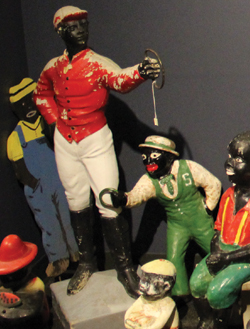 Racism On The LawnThe lawn jockey is a decorative yard ornament that caricatures black people and promotes the idea of their servitude. Typically a bandage replica virtually half-scale, it depicts a black human dressed in jockey's clothing carrying a lantern or a metal ring suitable for hitching a equus caballus. The black backyard jockeys oft take exaggerated features, such as bulging eyes, big blood-red lips, a apartment nose and curly hair. The flesh of the figure is usually a sleeky black color. Traditionally, two styles of backyard jockey have been produced: the stocky, hunched "Jocko" and the taller, thinner "Condescending Spirit." Both styles were nevertheless manufactured in 2012. Many Americans, especially African Americans, feel that backyard jockeys are racially offensive. It is common for homeowners to repaint the figure'south skin with pinkish or white paint to avert charges of being racially insensitive. |
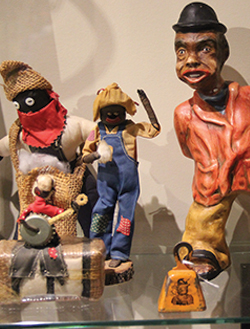 Caricaturing Black PeopleIn the United States, all racial groups have been caricatured, but none as often or in equally many ways equally blackness Americans. Blacks have been portrayed in popular culture as pitiable exotics, cannibalistic savages, hypersexual deviants, childlike buffoons, obedient servants, self-loathing victims, and menaces to society. These anti-black depictions routinely took class in material objects, such every bit ashtrays, drinking glasses, banks, games, line-fishing lures, detergent boxes, and other everyday items. This case holds objects that illustrate some of the major anti-black caricatures. Pickaninnies | 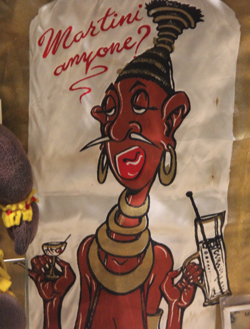 Brutal CaricatureThe Savage caricature showed Africans as animalistic, crazed, or comical cannibals, often with bones in their oversized lips. Fatigued from the pseudo-scientific early anthropological theories of the late 1800s, the Savage represented Africans as primitives who were less evolved than their supposedly superior European counterparts. | 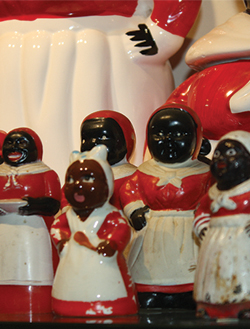 MammyFrom slavery through the Jim Crow period, the mammy extravaganza served the political, social, and economic interests of mainstream white America. During slavery, the mammy caricature presented the idea that blacks-in this instance, black women-were content, and even happy, equally slaves. Her wide smiling, hearty laugher, and loyal servitude were offered as testify of the supposed humanity of the establishment of slavery. The mammy caricature romanticized the realities of slave and servant life and obscured the unequal foundation of the master-servant power construction. Portrayed as an obese, coarse, maternal figure, the mammy had dandy dear for her white "family," only often treated her own family with disdain. Although she had children, sometimes many, she was, past mainstream standards, sexually unappealing. She "belonged" to the white family, though information technology was rarely stated. She was a faithful worker. She had no black friends; the white family was her entire globe. More information on the Mammy Caricature |
 Racist CartoonsBetween 1928 and 1950, America'due south premier animators-Walt Disney Corporation, Warner Bros., Metro-Goldwyn-Mayer, Merrie Melodies, Looney Tunes, and R.K.O. Radio Pictures-produced many cartoons that ridiculed the appearance, beliefs, and intelligence of African Americans and other racial and ethnic minorities. Racist Cartoons | 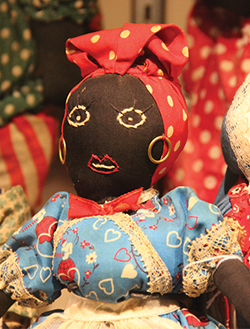 Charbonnet Doll CollectionFrom its inception, the Jim Crow Museum had dolls, mostly Mammy, Tom, and Pickaninny versions. In 2010, Marc Charbonnet, a prominent interior designer in New York, donated a collection of dolls to the Museum, including some that defame African Americans and some that exalt them and gloat African American culture. | 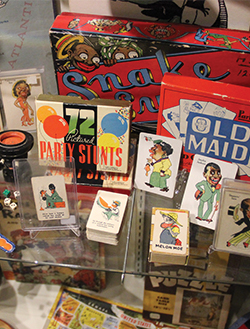 Games And ToysGames are constructive vehicles for spreading racial stereotypes and prejudice. All of the common caricatures of blacks were represented in games. Players, ofttimes children, received messages through a game's graphics and text that blacks were, for example, lazy or deviant and deserved to be mocked or hurt. |
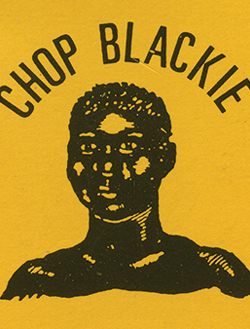 Racist ImportsIn 2011, approximately i-fourth of the objects in the Jim Crow Museum were produced in other countries, including Australia, Brazil, Canada, England, Hong Kong, Japan, Mexico, and Taiwan. |  The Northward-Give-and-takeThe word nigger is a shorthand way of saying that blacks possessed the moral, intellectual, social, and concrete characteristics of the Coon, Brute, Tom, Mammy, and other racial caricatures. Although considered by many people to be a mean slur, the give-and-take is used in unlike means and contexts to connote different meanings. More data on the North-Give-and-take |  Racism Every bit ArticleAll of the objects in the Jim Crow Museum have market values. In 2011, there were more than 50,000 collectors of "Black Americana," a category that includes racist artifacts. More often than not, the more racist an object is, the higher the cost it commands. |
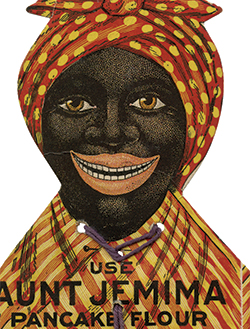 Aunt JemimaIn the 1880s, Chris Rutt, who had recently developed the idea of a cocky-rising pancake batter, attended a minstrel testify that included a skit with a southern mammy character named Aunt Jemima. Rutt and his partner, Charles Underwood, decided that the mammy, dressed in an apron and bandanna, would help distinguish and sell their pancake mix. When the R.T. Davis Mill Company purchased Rutt and Underwood's visitor, they employed a real person to portray Aunt Jemima in their marketing scheme. Nancy Green, built-in a slave in Kentucky in 1834, became the first "existent" Aunt Jemima. She impersonated Aunt Jemima until her death in 1923. At the 1893 World'south Exposition in Chicago, Dark-green, equally Aunt Jemima, sang songs, cooked pancakes, and told romanticized stories well-nigh the Old Southward as a happy place for blacks and whites. Afterwards, her image was plastered on billboards nationwide, with the explanation, "I'se in town, honey." In her role as Aunt Jemima, Dark-green made appearances at countless country fairs, flea markets, food shows, and local grocery stores. By the turn of the century, Aunt Jemima, along with the Armour meat chef, were the two commercial symbols nearly trusted by American housewives. A short video showing the marketing of Aunt Jemima and its impact on some peoples view of her today. Many consider Aunt Jemima as a kind, happy motherly figure who made great pancakes. Aunt Jemima, sang songs, cooked pancakes, and told romanticized stories nigh the Old S as a happy place for blacks and whites. But examine how these interpretations came to be and whether they were based on reality or in marketing. How many times does it have to telephone call Aunt Jemima "Happy" before everyone believes it? And does but maxim she is "Happy" make it so? Audio excerpts from the "Aunt Jemima Multifariousness Show" |

Source: https://www.ferris.edu/HTMLS/news/jimcrow/antiblack/index.htm
0 Response to "Vintage Black and White People Drawing Box"
Post a Comment