Who Is the Art Department Head at Mary Ward Catholic Secondary School
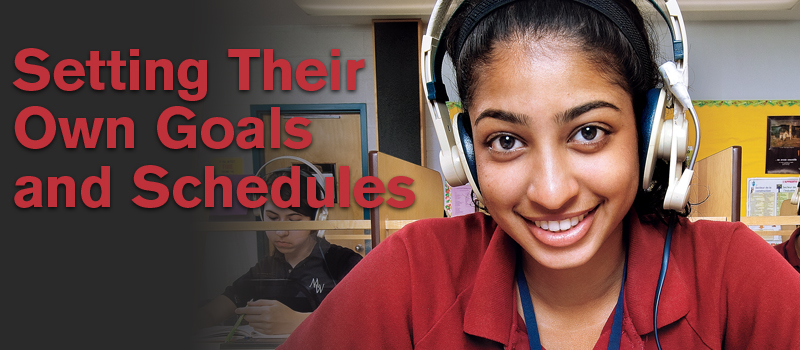
The structure and back up built into self-directed learning make information technology work.
past Nick Brune and Leanne Miller, OCT
From the outside it looks similar any other big, urban high school. It's the same when you lot first step inside. The halls are buzzing and teachers and didactics assistants are busy working with students, and those students are just as decorated studying and learning. Withal Mary Ward Catholic SS in the Toronto Catholic DSB is unlike whatever school you have e'er seen.
It offers a consummate academic program at all levels of study, as well as ESL and extended French. There are programs for students who are gifted and for those with developmental difficulties. And students participate in a total range of co-curricular athletics and student clubs.
But that's where the similarities end. Founded in 1985, Mary Ward is 1 of only six schools in Canada and 1 of just two in Ontario that delivers the standard curriculum through educatee-directed learning. Rather than learning in traditional teacher-directed classrooms, students report and acquire independently with the back up of a teacher-adviser programme.
Mary Ward's mission statement sums it up all-time, asserting that students flourish in a program of cocky-directed learning that calls on every student to exist a leader in an achievement-oriented environment, and that all students can accomplish their highest potential through self-directed learning.
In other words, explains principal Patricia Coburn, October, students set their own learning goals, follow a personalized program and work and learn in an environment that enables them to actively pursue self-directed learning.
There is no master timetable. There are no bells, no periods, no semesters and no traditional classrooms. Instead, courses based on the standard curriculum are divided into xviii learning units. Students work independently through one unit of measurement at a fourth dimension, post-obit a mastery learning philosophy that requires them to achieve a minimum of 60 per cent on all evaluated work before they tin can motility on to the next unit. The 18th unit is the final evaluation and involves an examination or culminating activity or a combination of the two, just as at near schools.
Mary Ward is a community school of about 1,150 students that gives first spots to Form 8 students from its six feeder schools. After that, applications are taken from within the board, with priority given to siblings of students already attending also equally those applying to the extended French program.
The other self-directed schoolhouse in Ontario is Westmount SS in the Hamilton-Wentworth DSB. Although both share a general philosophy, Westmount chief Rick Kunc, OCT, distinguishes between the two, explaining that Westmount was originally built every bit a traditional composite loftier school.
"We don't accept the space that Mary Ward has, so we run a more traditional timetable merely give students some freedom. Our approach involves an element of self-pacing and students directing their learning."
Westmount's 1,400 students come from the board'due south 96 simple schools. Students in Class 10 or higher from the board's 17 secondary schools may too apply.
Kunc explains that the self-paced model allows students to choose an academic plan that suits their abilities within the traditional viii courses, semestered system and regular timetable.
"If Marking wants to miss English language today to work on math, he can get to his English language teacher and conform to sign out of her class and work on his math in a location that better suits his learning needs for that period," Kunc explains. "But if the English language teacher is working on a key Hamlet lesson today, she may let Mark go tomorrow instead.
"When yous give students input into their own learning and the pace of that learning, they are more than successful," says Kunc. "Information technology's equally elementary as that."
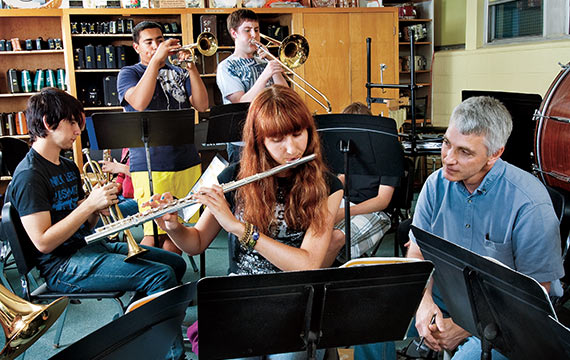
Ted Bohn, OCT, works with music students at Westmount SS in Hamilton.
A teacher's typical twenty-four hours at Mary Ward
The not-semestered schoolhouse is divided according to traditional subject departments. Each department has a large open resource area where students from all grades, power levels and subject-specific courses gather to work individually on their units. Subject teachers are always available – on the flooring, they phone call information technology – to answer questions and provide support. Each resource expanse has adjacent seminar rooms, interview rooms for i-on-i interviews and special-purpose rooms such as science and calculator labs. The school as well boasts three large lecture theatres where whatsoever department may schedule seminars and other large sessions.
Mary Ward teachers do not teach daily lessons in traditional classrooms. For the most part they work with students one-on-one during floor time. But in one case every two weeks or so, teachers lead focused classroom activities, known as seminars. Students must book subject-specific seminars into their schedules. Omnipresence is mandatory and taken.
In fact, at both schools teachers have attendance iii times a twenty-four hours. Self-directed learning has zippo to practice with kids choosing non to attend classes they don't enjoy.
Patrick McAlpine, Oct, teaches English at Mary Ward. He rarely teaches a whole class of students iii times a day, as he would at a neighbouring high schoolhouse. Instead, he's busy working on the flooring every 24-hour interval and meeting individually with his assigned English students before they manus in each unit of measurement of work. He points out errors, probes to ensure understanding and challenges them to improve their written work.
McAlpine laughs as he explains that many students proceed coming dorsum to make sure their piece of work is as perfect as possible before handing it in for final evaluation. "These kids are neat," he says.
In fact, nearly 85 per cent of Mary Ward students go on to college or university. At Westmount, the numbers are similar. About xc per cent choose an academic postsecondary pathway.
Kunc explains that Westmount'due south delivery model is founded on the belief that students take different learning styles. The school's plan affords them greater autonomy and more opportunities to direct their own learning.
Students study and learn independently with the support of a instructor-adviser program.
"This student-focused environment, which is nowadays in all Canadian Coalition of Self-Directed Learning member schools, has applications in whatever traditional education setting," he says.
In agreement with the Ontario English Catholic Teachers Association, Mary Ward teachers follow daily section-specific instructional schedules that give them three hours of bailiwick-based didactics (on-the-floor time), xl minutes of prep time and 1 hour of dedicated credit-based mentoring known as instructor-adviser fourth dimension. This involves completing the mandatory civics, career pedagogy, and leadership and learning skills courses.
The mentorship plan is the critical chemical element of the Mary Ward program. Each teacher – librarians and guidance counsellors included – is assigned xviii students from across all grades and levels of written report. Students remain in their teacher-adviser (TA) group for the four or 5 years they are at Mary Ward.
Westmount students vest to similar groups, although groups at Westmount meet only one time every 10 days. Mary Ward's 69 TA groups meet three times each day. The teacher-adviser takes omnipresence, and students update their teacher-adviser on their schedules.
In add-on, each group fellow member meets individually with the adviser once every two to 3 weeks for a 30-minute interview that covers brusque- and long-term scheduling, course selection, career planning and fourth dimension management. The meetings focus on pacing and course completion. After each coming together the TA sends home an electronic student progress report.
Mary Ward's high-tech wireless arrangement gives TAs consummate access to their advisees' marks, course data, tape of achievement, unit of measurement-completion progress, test results and other data. The arrangement makes information technology like shooting fish in a barrel and efficient to send reports and communicate with parents and guardians via e-mail.
A significant benefit of the TA plan is that each student develops a long-term relationship with ane developed who serves as an advocate and mentor, Coburn says.
Structured bookish supports make Mary Ward piece of work
The Mary Ward model relies on the vital work of instructional assistants (IAs) and instruction assistants (EAs). The chief seeks permission from the Toronto Catholic DSB for special staffing each year, every bit two IAs count for i teacher.
The jobs of the xiv IAs vary from section to department but typically include handing out and collecting booklets containing the learning units and helping organize labs. Two IAs run the school's testing lab, where students write tests when they complete a unit. Teachers are expected to have three or 4 versions of a exam available to ensure academic integrity.
And so a examination on Romeo and Juliet asks students to choose two quotations from a listing of five, place the speaker and the person spoken to, and explain the pregnant and significance of the quotation. For different versions of the test, the task remains the same just the quotations change.
If three students from the same grade arrive at the test eye together, the IA ensures that they sit separately and receive dissimilar versions of the same exam. If a student needs help during the test, the IA calls in the teacher.
As with any high school, Mary Ward students in any given course write their terminal examination on the aforementioned day and at the aforementioned time, although students who finish a course early tin write their exam early. Students work this out with their subject field teachers, and courses commonly run a block of exams in May, as many students finish then.
The 17 EAs work similar traditional EAs, supporting the school's Special Instruction teachers. I of the huge benefits of the Mary Ward system, explains Special Education teacher Joanna Morra, OCT, is that the children are almost fully integrated and work alongside all the other students during floor time. Morra, herself a Mary Ward grad, has been pedagogy for five years, all of them at Mary Ward.
This year, of the schoolhouse'southward 1,150 students, there are 90 identified students excluding gifted and 23 students identified with multiple exceptionalities and developmental delays.
"They sit and work alongside the regular-stream kids," Morra explains. "Even though there is little social interaction, my kids learn past doing and imitating. They come across the other students sitting still and working quietly, and they tend to exercise the same. There are fewer behavioural issues than if these kids were working solely with each other all day long."
Her students are grouped for song music, cooking and visual arts and receive one-on-ane teaching and assistance specific to their individual needs and levels of study.
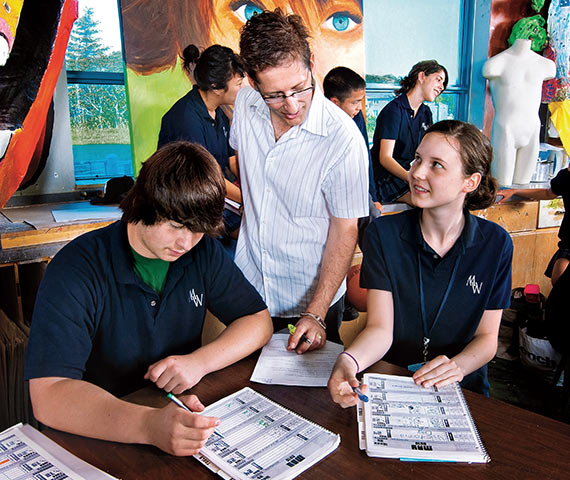
Mary Ward students piece of work on their agendas with teacher-adviser John Notten, October.
Summertime schoolhouse
Mary Ward offers summertime schoolhouse every bit a continuation of the regular plan, and summertime school supports the philosophy of continual progress didactics, mastery learning and student-directed learning. Students who take completed 14 of the 18 units of a course by the second week of June may enrol in the four-week summertime school program with the goal of completing a course. Alternatively, they may carry over every bit many as iv units to the next school year and must terminate all 18 units of a course past the beginning of Nov.
Although Westmount does not offer summer school, it too offers students a flexible carry-over process between two school years. "Educatee learning does not always stop in June. Extended timelines and increased student choice can positively bear upon student achievement in whatever school surroundings," Kunc says.
Keeping students organized
As at most schools, Mary Ward students receive an calendar book. But it'due south not cached at the bottom of a locker. Students must track their TA individual and group meetings, their subject teachers' on-the-floor and seminar schedules, and their own unit completion and marks. As tests must be taken within half dozen days of instructor say-so, they also keep track of how long they have to write a test. Their pre-marked agenda outlines target unit-completion dates also as dates to meet with teachers, holidays and field trips.
Students are given a daily planner that they must consummate every morn in their TA group equally they decide what they will work on. If teacher-advisers larn from subject teachers or through TA interviews that students are not attending floor fourth dimension, they will ask subject teachers to sign daily planners to ensure that students attend flooring fourth dimension for all subjects.
Students also receive a wall calendar to post at home, then parents and guardians are fully aware of target unit-completion dates and school events, too as the school's code of behaviour, its cell phone and uniform policies, the part of guidance and the library, written report tips, and so on.
"Communication with the dwelling house is vital to the success of our programme," explains Coburn. "Parents' involvement and support of their children is essential.
"Although in many ways the program is flexible," the master continues, "information technology is too structured, and students know where they should exist and what they should exist doing to attain success. They must practise the work and put in the time with the support and guidance provided past the subject teacher and teacher-adviser."
Jessica and Perrin are both in Grade 12 and are working quietly together in a small study room. Both have attended Mary Ward since Grade ix. They like the close relationship they have developed with their TA and experience confident they tin ask for advice or speak with this trusted adult on any topic. Both students savor the interaction with students in lower grades that their TA group affords them.
They admit that they struggled in Class nine to adjust to the programme, but now they love it and feel they are well prepared to attend academy next twelvemonth.
Jessica says, "I have stiff written report skills. I experience that I own my learning and can make proper decisions near time management and getting things done."
Both say they accept seen students take advantage of the organization past skipping classes and delaying the completion of work. Merely they have as well seen students suffer the consequences when everything comes due and they panic.
"It but happens once to a few kids," says Perrin, "and and so anybody finds out about it and doesn't want to be stressed like that. Information technology's not worth it."
Principles of self-directed schools
The Canadian Coalition of Self-Directed Learning is dedicated to the personalization of learning, which takes into account individual student characteristics, talents, interests and bookish backgrounds. Its philosophy is that learning flourishes in an environs where learners are able to practice a degree of control over their learning.
Although each member school of the coalition is unique, they all subscribe to ix central practices and values.
-
Teacher advisement: Teachers serve as coaches, mentors, facilitators and guides.
-
Flexible scheduling: Students command and direct their own learning.
-
Personalized programming: Wide choices enable students to customize their learning.
-
Collaborative teaching surroundings: Teachers engage in squad planning and co-operative delivery.
-
Interactive learning environment: Active learning, reflection and collaboration are emphasized.
-
Diagnosis of student developmental characteristics: Personalized instruction begins with an awareness of the learning styles, prior cognition and skills of each student.
-
Accurate cess: A variety of assessment strategies is used, from traditional to cutting edge.
-
Continuous progress: Learning takes place in different ways and at different rates and is continuously monitored.
-
Mastery learning: Learning takes place in manageable units. Students must demonstrate mastery by achieving at least threescore per cent on all evaluated piece of work before moving on to the next unit.
For more information on the Canadian Coalition of Self-Directed Learning, visit www.ccsdl.ca.
Source: https://professionallyspeaking.oct.ca/december_2010/features/self-directed.aspx
0 Response to "Who Is the Art Department Head at Mary Ward Catholic Secondary School"
Post a Comment