Study on the Art of Scientific Report Writing Emulation of Style
 Download Guide for Authors in PDF

Aims and Scope
Science of the Total Surroundings is an international multi-disciplinary journal for publication of novel, hypothesis-driven and loftier-bear on research on the full environment, which interfaces the atmosphere, lithosphere, hydrosphere, biosphere, and anthroposphere.
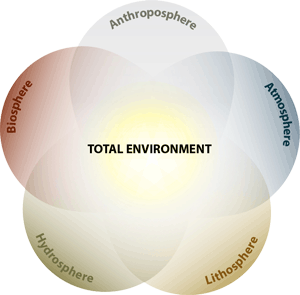
STOTEN invites contributions of original and loftier quality interdisciplinary environmental research papers of broad touch. Studies significantly advancing fundamental understanding and that focus on the interconnection of multiple spheres will be given primary consideration. Field studies have preference, while papers describing laboratory experiments must demonstrate significant advances in methodology or mechanistic understanding with a clear connexion to the environment. Descriptive, repetitive, incremental or regional-scale studies with limited novelty will not be considered.
ane) Subject areas may include, but are non express to:
• Air quality, atmospheric conditions, and new understanding of their role in adverse wellness or environmental outcomes
• Atmospheric biogeochemistry
• Ecosystem services and life cycle cess
• Ecotoxicology and gamble assessment
• Eco-hydrology
• Wildlife and contaminants
• Environmental impacts of climatic change, agriculture, forestry, and land uses
• Environmental impacts of waste product or wastewater handling
• Drinking water contaminants and health implication
• Environmental remediation of soil and groundwater
• Global change-induced farthermost events and ecology impacts
• Groundwater hydrogeochemistry and modeling
• Nanomaterials, microplastics, and other emerging contaminants
• Novel contaminant (bio)monitoring and chance assessment approaches
• Remote sensing and big data applications in multiple spheres
• Stress ecology in marine, freshwater, and terrestrial ecosystems
• Trace metals and organics in biogeochemical cycles
• Water quality and security
• Critical reviews or Word on current or emerging topics
• Fast-track submissions (less than 2 weeks): Ground-breaking discoveries with immediate bear on
ii) TYPES OF SUBMISSIONS NOT TO Be CONSIDERED :
• Papers not contributing significant new knowledge to the discipline
• Disciplinary studies with limited environmental relevance
• Local or regional calibration case studies lacking international relevance
• Soil or constitute science studies without ecology implications
• Laboratory batch experiments without an application component, due east.chiliad., batch sorption experiments, training, and evaluation of sorbents or catalysts for contaminant removal
• Manuscripts that are primarily data reports without a substantial hypothesis, east.g., monitoring of common contaminants
• Modelling studies without calibration and data validation
• Papers of social science in nature on economics, sociology, psychology, political science, policy, planning and/or management
•Toxicology and ecotoxicology studies testing single chemicals in demote-calibration assays
• Man wellness studies that do non provide significant additional agreement of air pollution induced health outcomes
• Method development papers on common contaminants
• Bibliometric analysis-based papers
Types of article
Research papers reporting original and previously unpublished work.
Brusque Communications . A brief communication of urgent matter or the reporting of preliminary findings to be given expedited publication.
Messages to the Editor . A written discussion of papers published in the journal. Letters are accustomed on the basis of new scientific insights on the particular topic, critical additional data, relevance to the published newspaper and timeliness. Authors volition be invited to submit a Reply to reply to points raised. The Editor will decide on the publication of Letters and Replies based on scientific merit, importance to the raised problems, and interest to the general audience. Letters and Replies of an unprofessional or unscientific nature, or containing personal invective, will not be considered.
Review Manufactures . Critical evaluation of existing information, defined topics or emerging fields of investigation, critical issues of public concern.
Give-and-take . Opinionated exposition on an important scientific issue or event designed to stimulate further discussion in a broader scientific forum.
Special Issues . Proceedings of symposia, workshops and/or conferences volition be considered for publication as a special outcome. An Editor or Associate Editor should be contacted early in the conference planning procedure to get approval and for guidelines on special issues of the journal. Full data can be found hither. Editorials for Special issues are submitted past invitation but through the Editorial Manager portal.
Submission checklist
You tin can use this list to comport out a final check of your submission before y'all transport it to the journal for review. Delight check the relevant section in this Guide for Authors for more than details.
Ensure that the following items are present:
Only one author is designated every bit the corresponding writer with contact details:
• Due east-postal service accost
• Full postal address
All necessary files have been uploaded:
Manuscript:
• Include keywords
• All figures (include relevant captions)
• All tables (including titles, description, footnotes)
• Ensure all figure and table citations in the text friction match the files provided
• Betoken conspicuously if color should be used for whatever figures in print
Graphical Abstracts / Highlights files (convey the primary bulletin of described report)
Supplemental files (must accept the same championship page as the main newspaper)
Further considerations
• Manuscript has been 'spell checked' and 'grammar checked'
• All references mentioned in the Reference List are cited in the text, and vice versa
• Limit the full number of figures and tables to no more than 8, place secondary figures and tables, pictorial figures, and over-sized tables in Supplementary Material
•Permission has been obtained for use of copyrighted cloth from other sources (including the Internet)
• A competing interests argument is provided, even if the authors have no competing interests to declare
• Journal policies detailed in this guide have been reviewed
• Suggested reviewers should be from diverse regions, with contact details
For further information, visit our Back up Centre

Authors should include a statement in the manuscript that informed consent was obtained for experimentation with human subjects. The privacy rights of human subjects must ever be observed.
All animal experiments should comply with the ARRIVE guidelines and should exist carried out in accord with the U.K. Animals (Scientific Procedures) Act, 1986 and associated guidelines, EU Directive 2010/63/EU for fauna experiments, or the National Research Council'due south Guide for the Intendance and Utilise of Laboratory Animals and the authors should clearly indicate in the manuscript that such guidelines take been followed. The sex of animals must be indicated, and where appropriate, the influence (or association) of sex on the results of the study.
Declaration of competing involvement
Corresponding authors, on behalf of all the authors of a submission, must disclose any financial and personal relationships with other people or organizations that could inappropriately influence (bias) their work. Examples of potential conflicts of interest include employment, consultancies, stock ownership, honoraria, paid expert testimony, patent applications/registrations, and grants or other funding. All authors, including those without competing interests to declare, should provide the relevant data to the corresponding author (which, where relevant, may specify they have nothing to declare). Corresponding authors should then use this tool to create a shared argument and upload to the submission organization at the Attach Files step. Please do not convert the .docx template to some other file blazon. Author signatures are not required.
Submission announcement and verification
Submission of an article implies that the piece of work described has not been published previously (except in the grade of an abstract, a published lecture or academic thesis, see 'Multiple, redundant or concurrent publication' for more information), that information technology is not under consideration for publication elsewhere, that its publication is approved by all authors and tacitly or explicitly past the responsible government where the work was carried out, and that, if accepted, it will not be published elsewhere in the same form, in English or in whatsoever other language, including electronically without the written consent of the copyright-holder. To verify originality, your article may be checked by the originality detection service Crossref Similarity Check.
Preprints
Delight note that preprints can exist shared anywhere at any time, in line with Elsevier's sharing policy. Sharing your preprints e.g. on a preprint server volition not count as prior publication (see 'Multiple, redundant or concurrent publication' for more information).
Preprint posting on SSRN
In support of Open Science, this journal offers its authors a costless preprint posting service. Preprints provide early registration and broadcasting of your enquiry, which facilitates early citations and collaboration.
During submission to Editorial Director, you can choose to release your manuscript publicly equally a preprint on the preprint server SSRN once it enters peer-review with the journal. Your choice will have no consequence on the editorial process or outcome with the journal. Delight annotation that the corresponding author is expected to seek blessing from all co-authors before agreeing to release the manuscript publicly on SSRN.
You will be notified via email when your preprint is posted online and a Digital Object Identifier (DOI) is assigned. Your preprint will remain globally available free to read whether the journal accepts or rejects your manuscript.
For more than information about posting to SSRN, please consult the SSRN Terms of Apply and FAQs.
Utilise of inclusive language
Inclusive language acknowledges diversity, conveys respect to all people, is sensitive to differences, and promotes equal opportunities. Content should brand no assumptions about the beliefs or commitments of whatsoever reader; contain nothing which might imply that one private is superior to another on the grounds of age, gender, race, ethnicity, culture, sexual orientation, disability or health condition; and apply inclusive language throughout. Authors should ensure that writing is free from bias, stereotypes, slang, reference to ascendant civilisation and/or cultural assumptions. We advise to seek gender neutrality by using plural nouns ("clinicians, patients/clients") as default/wherever possible to avoid using "he, she," or "he/she." We recommend avoiding the use of descriptors that refer to personal attributes such as historic period, gender, race, ethnicity, civilisation, sexual orientation, disability or health condition unless they are relevant and valid. When coding terminology is used, we recommend to avoid offensive or exclusionary terms such as "chief", "slave", "blacklist" and "whitelist". Nosotros propose using alternatives that are more appropriate and (cocky-) explanatory such as "primary", "secondary", "blocklist" and "allowlist". These guidelines are meant as a betoken of reference to aid identify appropriate linguistic communication but are by no ways exhaustive or definitive.
Author contributions
For transparency, we encourage authors to submit an author statement file outlining their individual contributions to the paper using the relevant CRediT roles: Conceptualization; Data curation; Formal analysis; Funding conquering; Investigation; Methodology; Project assistants; Resources; Software; Supervision; Validation; Visualization; Roles/Writing - original draft; Writing - review & editing. Authorship statements should be formatted with the names of authors offset and CRediT function(due south) post-obit. More details and an instance.
Changes to authorship
Authors are expected to consider carefully the list and gild of authors before submitting their manuscript and provide the definitive list of authors at the time of the original submission. Any add-on, deletion or rearrangement of author names in the authorship list should exist made only before the manuscript has been accepted and but if approved by the journal Editor. To asking such a alter, the Editor must receive the following from the respective author: (a) the reason for the alter in author list and (b) written confirmation (e-mail, letter) from all authors that they concur with the addition, removal or rearrangement. In the case of addition or removal of authors, this includes confirmation from the author being added or removed.
Only in exceptional circumstances will the Editor consider the improver, deletion or rearrangement of authors later the manuscript has been accustomed. While the Editor considers the request, publication of the manuscript will exist suspended. If the manuscript has already been published in an online effect, any requests canonical by the Editor volition result in a corrigendum.
Article transfer service
This periodical is office of our Article Transfer Service. This means that if the Editor feels your article is more suitable in ane of our other participating journals, then you may be asked to consider transferring the article to one of those. If you hold, your article volition exist transferred automatically on your behalf with no need to reformat. Please note that your article will be reviewed once again by the new journal. More than information.
Copyright
Upon credence of an article, authors will be asked to complete a 'Journal Publishing Agreement' (see more information on this). An e-mail volition be sent to the corresponding author confirming receipt of the manuscript together with a 'Journal Publishing Agreement' form or a link to the online version of this agreement.
Subscribers may reproduce tables of contents or prepare lists of articles including abstracts for internal circulation inside their institutions. Permission of the Publisher is required for resale or distribution outside the establishment and for all other derivative works, including compilations and translations. If excerpts from other copyrighted works are included, the author(south) must obtain written permission from the copyright owners and credit the source(s) in the article. Elsevier has preprinted forms for use past authors in these cases.
For gilt open admission articles: Upon acceptance of an article, authors will be asked to complete a 'License Agreement' (more than information). Permitted third party reuse of golden open access manufactures is determined past the writer's option of user license.
Author rights
As an writer you (or your employer or institution) accept certain rights to reuse your work. More information.
Elsevier supports responsible sharing
Find out how you can share your enquiry published in Elsevier journals.
Role of the funding source
Y'all are requested to identify who provided fiscal support for the conduct of the enquiry and/or training of the article and to briefly draw the role of the sponsor(due south), if any, in written report pattern; in the collection, analysis and estimation of information; in the writing of the report; and in the determination to submit the article for publication. If the funding source(s) had no such involvement, information technology is recommended to country this.
Elsevier Researcher Academy
Researcher Academy is a gratis e-learning platform designed to support early and mid-career researchers throughout their inquiry journeying. The "Larn" environment at Researcher Academy offers several interactive modules, webinars, downloadable guides and resources to guide you through the process of writing for research and going through peer review. Feel free to use these free resources to amend your submission and navigate the publication process with ease.
Linguistic communication (usage and editing services)
Please write your text in good English (American or British usage is accepted, but not a mixture of these). Authors who experience their English language language manuscript may crave editing to eliminate possible grammatical or spelling errors and to arrange to correct scientific English may wish to use the English language Language Editing service available from Elsevier's Author Services.
Submission
Authors may submit their manufactures electronically to this journal. The system automatically converts source files to a single PDF file of the article, which is used in the peer-review process. Please annotation that even though manuscript source files are converted to a PDF file at submission for the review process, these source files are needed for farther processing after acceptance. All correspondence, including notification of the Editor's decision and requests for revision, takes identify by e-mail, removing the need for a paper trail.
Annotation that contributions may exist either submitted online or sent past mail. Delight practise Non submit via both routes. This will cause confusion and may pb to your article being reviewed and published twice!
For any technical queries please visit our Support Middle.
Comprehend Letter
The corresponding author must state explicitly in a paragraph how the paper fits the Aims and Scope of the journal. Failure to include the paragraph will effect in returning the paper to the author.
Referees
All authors must suggest SIX potential reviewers for their paper upon submission (please include
institutional email addresses ONLY for all reviewers).
The suggested referees should:
- (i) non exist close collaborators of the authors(south)
- (ii) not exist located in the same establishment as the author(s) and
- (iii) non all exist from the habitation country.
Avoid suggesting colleagues you have published with previously as this creates a potential conflict of involvement. Do not advise any Editor of this journal.

Queries
For questions well-nigh the editorial process (including the status of manuscripts nether review) or for technical support on submissions, delight visit our Support Center.
NEW SUBMISSIONS
Submission to this journal proceeds totally online and you lot will be guided stepwise through the cosmos and uploading of your files. The system automatically converts your files to a single PDF file, which is used in the peer-review process.
As office of the Your Paper Your Way service, you lot may choose to submit your manuscript equally a single file to be used in the refereeing procedure. This tin exist a PDF file or a Word document, in any format or lay-out that can be used by referees to evaluate your manuscript. It should contain high enough quality figures for refereeing. If yous prefer to do so, you may still provide all or some of the source files at the initial submission. Delight note that individual figure files larger than 10 MB must be uploaded separately.
References
There are no strict requirements on reference formatting at submission. References tin be in any style or format as long as the style is consistent. Where applicable, author(s) name(south), journal championship/book title, chapter title/article championship, year of publication, volume number/volume affiliate and the article number or pagination must exist present. Use of DOI is highly encouraged. The reference style used past the journal will be applied to the accustomed commodity by Elsevier at the proof stage. Note that missing data will exist highlighted at proof stage for the author to correct.
LINE and PAGE NUMBERING (NEW AND REVISED SUBMISSIONS):
Please ensure the text of your paper is double-spaced and has sequent(continuous) LINE numbering. Delight also ensure to add together Folio numbers to the source file- this is an essential peer review requirement.
Figures and tables
You may embed figures and tables in your WORD manuscript or submit Figures and Tables in separate files in an canonical format (TIFF or EPS with the right resolution for figures and MS Office files for tables)
Peer review
This journal operates a unmarried anonymized review process. All contributions will be initially assessed past the editor for suitability for the journal. Papers deemed suitable are then typically sent to a minimum of 2 independent adept reviewers to appraise the scientific quality of the newspaper. The Editor is responsible for the concluding decision regarding acceptance or rejection of articles. The Editor's decision is final. Editors are not involved in decisions well-nigh papers which they have written themselves or have been written by family members or colleagues or which relate to products or services in which the editor has an interest. Any such submission is subject area to all of the periodical's usual procedures, with peer review handled independently of the relevant editor and their research groups. More information on types of peer review.
REVISED SUBMISSIONS
Use of discussion processing software
Regardless of the file format of the original submission, at revision yous must provide us with an editable file of the unabridged article. Go on the layout of the text equally simple as possible. Nigh formatting codes volition be removed and replaced on processing the article. The electronic text should be prepared in a way very similar to that of conventional manuscripts (see as well the Guide to Publishing with Elsevier). See likewise the department on Electronic artwork.
To avoid unnecessary errors you are strongly advised to utilise the 'spell-check' and 'grammer-bank check' functions of your discussion processor.
Article structure
Manuscript page limit
At that place is no restriction on the number of pages but brevity of papers is profoundly encouraged. The length of a paper should be commensurate with the scientific information existence reported. In item, the introductory material should be limited to a few paragraphs and results presented in figures should non be repeated in tables.
Subdivision - numbered sections
Divide your article into clearly defined and numbered sections. Subsections should exist numbered 1.ane (so 1.1.i, 1.1.2, ...), 1.two, etc. (the abstract is not included in section numbering). Use this numbering also for internal cross-referencing: do not just refer to 'the text'. Any subsection may be given a cursory heading. Each heading should announced on its own split up line.
Introduction
State the objectives of the work and provide an adequate background, avoiding a detailed literature survey or a summary of the results.
Material and methods
Provide sufficient details to allow the work to be reproduced by an independent researcher. Methods that are already published should exist summarized, and indicated by a reference. If quoting directly from a previously published method, apply quotation marks and also cite the source. Any modifications to existing methods should also be described.
Theory/calculation
A Theory department should extend, not repeat, the groundwork to the commodity already dealt with in the Introduction and lay the foundation for farther work. In contrast, a Calculation section represents a practical development from a theoretical basis.
Results
Results should be clear and concise.
Discussion
This should explore the significance of the results of the work, not echo them. A combined Results and Give-and-take department is ofttimes advisable. Avoid extensive citations and give-and-take of published literature.
Conclusions
The principal conclusions of the study may be presented in a brusk Conclusions department, which may stand alone or form a subsection of a Word or Results and Discussion section.
Appendices
If in that location is more than i appendix, they should be identified equally A, B, etc. Formulae and equations in appendices should exist given dissever numbering: Eq. (A.1), Eq. (A.2), etc.; in a subsequent appendix, Eq. (B.i) and so on. Similarly for tables and figures: Tabular array A.i; Fig. A.1, etc.
Essential title page information
• Title. Be concise and informative. Titles are often used in information-retrieval systems. Acronyms and brand names of products should not appear in the title of a paper. Instead they may be listed in the key words, and spelled out the offset time they announced in the body of the newspaper.
• Writer names and affiliations. Please clearly indicate the given name(s) and family name(s) of each author and cheque that all names are accurately spelled. Nowadays the authors' amalgamation addresses (where the actual work was done) beneath the names. Signal all affiliations with a lower-case superscript letter immediately after the author'due south proper noun and in front of the appropriate address. Provide the full postal address of each affiliation, including the land name and, if available, the e-mail address of each writer.
• Respective author. Clearly indicate who volition handle correspondence at all stages of refereeing and publication, also post-publication. The inclusion of multiple corresponding authors is strongly discouraged. Ensure that the electronic mail address is given and that contact details are kept up to engagement past the corresponding author.
• Present/permanent address. If an writer has moved since the work described in the article was done, or was visiting at the time, a 'Nowadays address' (or 'Permanent address') may be indicated every bit a footnote to that author's proper name. The address at which the author really did the work must exist retained as the chief, amalgamation address. Superscript Arabic numerals are used for such footnotes.
Highlights
Highlights are mandatory for this journal as they help increase the discoverability of your commodity via search engines. They consist of a curt collection of bullet points that capture the novel results of your research as well as new methods that were used during the report (if whatever). Please have a look at the examples here: example Highlights.
Highlights should be submitted in a carve up editable file in the online submission system. Please utilise 'Highlights' in the file proper noun and include 3 to v bullet points (maximum 85 characters, including spaces, per bullet point).
A concise and factual abstract is required. The abstract should state briefly the purpose of the research, the principal results and major conclusions. An abstract is frequently presented separately from the commodity, and then it must be able to stand up alone. For this reason, References should be avoided, but if essential, then cite the author(s) and yr(s). Also, non-standard or uncommon abbreviations should be avoided, but if essential they must be divers at their outset mention in the abstract itself.Please limit your abstract to 300 words .
Mandatory graphical abstruse
A graphical abstruse is mandatory for all Research Papers, Review Articles and Short Communications submitted to this journal. It does not demand to be uploaded with the initial submission but must exist supplied with any subsequent revisions. It should summarize the contents of the article in a concise, pictorial form designed to capture the attention of a wide readership online. Authors must provide images that clearly stand for the work described in the article. Graphical abstracts should be submitted equally a split file in the online submission system. Image size: please provide an image with a minimum of 531 × 1328 pixels (h × w) or proportionally more than. The image should be readable at a size of 5 × 13 cm using a regular screen resolution of 96 dpi. Preferred file types: TIFF, EPS, PDF or MS Role files. You can view Example Graphical Abstracts on our information site.
Authors can make apply of Elsevier'southward Illustration Services to ensure the all-time presentation of their images also in accordance with all technical requirements.
The mandatory highlights are important considering they announced online in the Table of Contents of the periodical. Highlights that list bullet points well-nigh the results are therefore not very informative for readers scanning the contents. Here is an outline of what the highlights should contain:
- What is the overall scientific trouble and why did you written report it?
- How did you accost the trouble, and which spheres are included?
- What was the major method used?
- Major finding(south)
- Have home message
Practise not repeat the highlights in bullet form for the conclusions. The conclusions should be a narrative about what y'all found and what information technology means in the broader scheme.
Keywords
Immediately after the abstract, provide a maximum of half-dozen keywords, using American spelling and avoiding general and plural terms and multiple concepts (avoid, for instance, 'and', 'of'). Be sparing with abbreviations: just abbreviations firmly established in the field may be eligible. These keywords volition be used for indexing purposes.
The key words of the newspaper should not contain any words already in the title, just tin can include abbreviated terms or location data not suitable for the title.
Abbreviations
Define abbreviations that are not standard in this field in a footnote to exist placed on the showtime folio of the article. Such abbreviations that are unavoidable in the abstract must be divers at their first mention there, besides every bit in the footnote. Ensure consistency of abbreviations throughout the article.
Acknowledgements
Collate acknowledgements in a separate section at the finish of the commodity before the references and do not, therefore, include them on the title folio, as a footnote to the championship or otherwise. List hither those individuals who provided help during the research (e.g., providing language help, writing assistance or proof reading the commodity, etc.).
Formatting of funding sources
List funding sources in this standard way to facilitate compliance to funder's requirements:
Funding: This work was supported by the National Institutes of Wellness [grant numbers xxxx, yyyy]; the Neb & Melinda Gates Foundation, Seattle, WA [grant number zzzz]; and the United states Institutes of Peace [grant number aaaa].
It is non necessary to include detailed descriptions on the program or type of grants and awards. When funding is from a cake grant or other resource available to a university, higher, or other research establishment, submit the name of the plant or organization that provided the funding.
If no funding has been provided for the inquiry, it is recommended to include the following sentence:
This research did not receive whatsoever specific grant from funding agencies in the public, commercial, or not-for-turn a profit sectors.
Footnotes
Footnotes should be used sparingly. Number them consecutively throughout the article. Many give-and-take processors build footnotes into the text, and this feature may be used. Should this non be the case, indicate the position of footnotes in the text and present the footnotes themselves separately at the finish of the article.
Artwork
Electronic artwork
General points
• Make sure you use compatible lettering and sizing of your original artwork.
• Preferred fonts: Arial (or Helvetica), Times New Roman (or Times), Symbol, Courier.
• Number the illustrations co-ordinate to their sequence in the text.
• Use a logical naming convention for your artwork files.
• Indicate per figure if it is a single, 1.5 or 2-cavalcade plumbing fixtures epitome.
• For Word submissions only, you may even so provide figures and their captions, and tables within a single file at the revision stage.
• Please note that individual figure files larger than 10 MB must exist provided in carve up source files.
A detailed guide on electronic artwork is available.
You are urged to visit this site; some excerpts from the detailed information are given here.
Formats
Regardless of the application used, when your electronic artwork is finalized, please 'salve equally' or convert the images to i of the following formats (note the resolution requirements for line drawings, halftones, and line/halftone combinations given below):
EPS (or PDF): Vector drawings. Embed the font or salvage the text as 'graphics'.
TIFF (or JPG): Color or grayscale photographs (halftones): always use a minimum of 300 dpi.
TIFF (or JPG): Bitmapped line drawings: employ a minimum of one thousand dpi.
TIFF (or JPG): Combinations bitmapped line/half-tone (color or grayscale): a minimum of 500 dpi is required.
Please do not:
• Supply files that are optimized for screen use (e.g., GIF, BMP, PICT, WPG); the resolution is too depression.
• Supply files that are too low in resolution.
• Submit graphics that are disproportionately large for the content.
Color artwork
Please brand sure that artwork files are in an adequate format (TIFF (or JPEG), EPS (or PDF), or MS Office files) and with the right resolution. If, together with your accepted commodity, you submit usable color figures then Elsevier will ensure, at no additional accuse, that these figures will announced in colour online (e.grand., ScienceDirect and other sites) regardless of whether or not these illustrations are reproduced in color in the printed version. For color reproduction in print, yous will receive information regarding the costs from Elsevier subsequently receipt of your accepted article. Please indicate your preference for color: in print or online only. Further information on the preparation of electronic artwork.
Figure captions
Ensure that each illustration has a caption. A caption should comprise a brief title (not on the effigy itself) and a description of the analogy. Continue text in the illustrations themselves to a minimum but explain all symbols and abbreviations used.
Tables
Number tables consecutively with Standard arabic numerals in accord with their appearance in the text. Type each table double-spaced on a separate page with a short descriptive championship typed straight higher up and place footnotes to tables below the tabular array body and betoken them with superscript lowercase letters. Avoid vertical rules. Be sparing in the apply of tables and ensure that the data presented in tables do not duplicate results described elsewhere in the article. Tables should never be included within the text, considering file(s) containing tables are attached separately in the electronic submission system.
Delight submit Figures and Tables in separate files in an approved format (TIFF or EPS with the correct resolution for figures and MS Office files for tables).
References
Citation in text
Please ensure that every reference cited in the text is as well nowadays in the reference list (and vice versa). Whatsoever references cited in the abstract must exist given in full. Unpublished results and personal communications are not recommended in the reference listing, but may be mentioned in the text. If these references are included in the reference list they should follow the standard reference style of the journal and should include a substitution of the publication appointment with either 'Unpublished results' or 'Personal communication'. Citation of a reference every bit 'in press' implies that the item has been accepted for publication.
Reference links
Increased discoverability of research and high quality peer review are ensured by online links to the sources cited. In club to allow us to create links to abstracting and indexing services, such as Scopus, CrossRef and PubMed, please ensure that data provided in the references are correct. Please note that incorrect surnames, journal/book titles, publication year and pagination may forbid link creation. When copying references, please be careful every bit they may already comprise errors. Apply of the DOI is highly encouraged.
A DOI is guaranteed never to alter, so you lot tin can use it as a permanent link to any electronic commodity. An example of a citation using DOI for an article non even so in an effect is: VanDecar J.C., Russo R.M., James D.E., Ambeh W.B., Franke M. (2003). Aseismic continuation of the Bottom Antilles slab beneath northeastern Venezuela. Periodical of Geophysical Research, https://doi.org/10.1029/2001JB000884. Please note the format of such citations should be in the same style as all other references in the paper.
Web references
As a minimum, the full URL should be given and the date when the reference was last accessed. Any further information, if known (DOI, author names, dates, reference to a source publication, etc.), should also exist given. Web references tin can be listed separately (e.thou., after the reference list) under a different heading if desired, or tin can exist included in the reference list.
Data references
This journal encourages you to cite underlying or relevant datasets in your manuscript past citing them in your text and including a data reference in your Reference List. Data references should include the following elements: writer name(s), dataset title, data repository, version (where bachelor), yr, and global persistent identifier. Add [dataset] immediately before the reference so nosotros can properly identify it as a data reference. The [dataset] identifier volition non announced in your published commodity.
References in a special result
Please ensure that the words 'this consequence' are added to any references in the list (and any citations in the text) to other articles in the same Special Issue.
Reference management software
Well-nigh Elsevier journals have their reference template available in many of the virtually popular reference management software products. These include all products that support Citation Style Linguistic communication styles, such equally Mendeley. Using citation plug-ins from these products, authors only need to select the appropriate journal template when preparing their article, afterwards which citations and bibliographies will exist automatically formatted in the periodical'due south style. If no template is yet available for this periodical, please follow the format of the sample references and citations as shown in this Guide. If you lot use reference management software, please ensure that y'all remove all field codes before submitting the electronic manuscript. More information on how to remove field codes from different reference management software.
Reference formatting
There are no strict requirements on reference formatting at submission. References can exist in any fashion or format every bit long equally the way is consistent. Where applicative, author(southward) name(due south), journal title/book title, chapter title/article title, twelvemonth of publication, volume number/volume chapter and the article number or pagination must exist nowadays. Use of DOI is highly encouraged. The reference style used past the journal will be applied to the accepted commodity by Elsevier at the proof stage. Note that missing data will be highlighted at proof phase for the author to correct. If y'all exercise wish to format the references yourself they should be arranged according to the following examples:
Reference way
Text: All citations in the text should refer to:
1. Unmarried author: the author'due south proper noun (without initials, unless in that location is ambiguity) and the year of publication;
2. Two authors: both authors' names and the year of publication;
3. Three or more authors: get-go author'southward proper noun followed by 'et al.' and the year of publication.
Citations may be made directly (or parenthetically). Groups of references tin exist listed either first alphabetically, so chronologically, or vice versa.
Examples: 'as demonstrated (Allan, 2000a, 2000b, 1999; Allan and Jones, 1999)…. Or, as demonstrated (Jones, 1999; Allan, 2000)… Kramer et al. (2010) take recently shown …'
List: References should be arranged first alphabetically so further sorted chronologically if necessary. More than one reference from the same author(s) in the same year must be identified by the letters 'a', 'b', 'c', etc., placed after the year of publication.
Examples:
Reference to a journal publication:
Van der Geer, J., Hanraads, J.A.J., Lupton, R.A., 2010. The fine art of writing a scientific article. J. Sci. Commun. 163, 51–59. https://doi.org/10.1016/j.Sc.2010.00372.
Reference to a journal publication with an article number:
Van der Geer, J., Hanraads, J.A.J., Lupton, R.A., 2018. The art of writing a scientific article. Heliyon. 19, e00205. https://doi.org/ten.1016/j.heliyon.2018.e00205.
Reference to a book:
Strunk Jr., W., White, E.B., 2000. The Elements of Manner, fourth ed. Longman, New York.
Reference to a chapter in an edited book:
Mettam, G.R., Adams, L.B., 2009. How to prepare an electronic version of your article, in: Jones, B.Southward., Smith , R.Z. (Eds.), Introduction to the Electronic Historic period. E-Publishing Inc., New York, pp. 281–304.
Reference to a website:
Cancer Enquiry Uk, 1975. Cancer statistics reports for the UK. http://www.cancerresearchuk.org/aboutcancer/statistics/cancerstatsreport/ (accessed 13 March 2003).
Reference to a dataset:
[dataset] Oguro, 1000., Imahiro, S., Saito, Due south., Nakashizuka, T., 2015. Mortality data for Japanese oak wilt disease and surrounding wood compositions. Mendeley Data, v1. https://doi.org/10.17632/xwj98nb39r.1.
Reference to software:
Coon, Eastward., Berndt, M., Jan, A., Svyatsky, D., Atchley, A., Kikinzon, E., Harp, D., Manzini, G., Shelef, East., Lipnikov, K., Garimella, R., Xu, C., Moulton, D., Karra, Southward., Painter, Southward., Jafarov, E., & Molins, South., 2020. Advanced Terrestrial Simulator (ATS) v0.88 (Version 0.88). Zenodo. https://doi.org/10.5281/zenodo.3727209.
Video
Elsevier accepts video fabric and animation sequences to support and heighten your scientific enquiry. Authors who accept video or animation files that they wish to submit with their article are strongly encouraged to include links to these within the trunk of the commodity. This tin can be washed in the same way equally a figure or table by referring to the video or blitheness content and noting in the body text where it should be placed. All submitted files should be properly labeled and so that they directly chronicle to the video file's content. In guild to ensure that your video or animation material is directly usable, please provide the file in ane of our recommended file formats with a preferred maximum size of 150 MB per file, i GB in total. Video and animation files supplied will exist published online in the electronic version of your article in Elsevier Web products, including ScienceDirect. Please supply 'stills' with your files: you can choose any frame from the video or blitheness or brand a separate epitome. These volition exist used instead of standard icons and volition personalize the link to your video data. For more detailed instructions please visit our video instruction pages. Annotation: since video and animation cannot exist embedded in the print version of the journal, delight provide text for both the electronic and the print version for the portions of the article that refer to this content.
Information visualization
Include interactive information visualizations in your publication and let your readers interact and engage more closely with your inquiry. Follow the instructions here to find out nigh available data visualization options and how to include them with your article.
Supplementary material
Supplementary material such as applications, images and sound clips, can be published with your commodity to enhance it. Submitted supplementary items are published exactly as they are received (Excel or PowerPoint files will appear as such online). Delight submit your material together with the article and supply a curtailed, descriptive caption for each supplementary file. If you wish to make changes to supplementary material during whatever stage of the procedure, please make sure to provide an updated file. Do not comment whatsoever corrections on a previous version. Please switch off the 'Track Changes' option in Microsoft Office files as these will appear in the published version.
Enquiry data
This periodical encourages and enables you to share data that supports your research publication where appropriate, and enables y'all to interlink the data with your published manufactures. Research information refers to the results of observations or experimentation that validate inquiry findings. To facilitate reproducibility and data reuse, this journal likewise encourages yous to share your software, code, models, algorithms, protocols, methods and other useful materials related to the project.
Below are a number of ways in which y'all can associate information with your article or make a statement well-nigh the availability of your data when submitting your manuscript. If yous are sharing information in one of these means, you lot are encouraged to cite the data in your manuscript and reference listing. Please refer to the "References" section for more data about data citation. For more data on depositing, sharing and using inquiry data and other relevant research materials, visit the inquiry data folio.
Data linking
If you lot take made your research data available in a data repository, you can link your commodity directly to the dataset. Elsevier collaborates with a number of repositories to link articles on ScienceDirect with relevant repositories, giving readers access to underlying data that gives them a better understanding of the inquiry described.
There are different ways to link your datasets to your article. When available, yous tin can directly link your dataset to your commodity past providing the relevant information in the submission system. For more data, visit the database linking page.
For supported data repositories a repository imprint will automatically appear adjacent to your published article on ScienceDirect.
In add-on, you can link to relevant information or entities through identifiers within the text of your manuscript, using the following format: Database: xxxx (due east.g., TAIR: AT1G01020; CCDC: 734053; PDB: 1XFN).
Mendeley Data
This journal supports Mendeley Data, enabling yous to deposit any research data (including raw and processed information, video, code, software, algorithms, protocols, and methods) associated with your manuscript in a free-to-utilize, open up access repository. During the submission process, later uploading your manuscript, you will have the opportunity to upload your relevant datasets directly to Mendeley Data. The datasets will be listed and directly attainable to readers adjacent to your published article online.
For more information, visit the Mendeley Information for journals page.
Data in Cursory
You lot take the choice of converting whatever or all parts of your supplementary or boosted raw data into a data commodity published in Information in Brief. A information commodity is a new kind of commodity that ensures that your data are actively reviewed, curated, formatted, indexed, given a DOI and fabricated publicly bachelor to all upon publication (watch this video describing the benefits of publishing your data in Information in Brief). You lot are encouraged to submit your data article for Data in Brief equally an additional item direct aslope the revised version of your manuscript. If your research commodity is accepted, your data article will automatically exist transferred over to Data in Brief where it volition exist editorially reviewed, published open access and linked to your research article on ScienceDirect. Delight notation an open admission fee is payable for publication in Data in Brief. Full details tin be found on the Information in Brief website. Please use this template to write your Data in Brief data article.
MethodsX
You accept the option of converting relevant protocols and methods into i or multiple MethodsX articles, a new kind of article that describes the details of customized research methods. Many researchers spend a significant amount of time on developing methods to fit their specific needs or setting, merely often without getting credit for this part of their work. MethodsX, an open up access journal, now publishes this data in order to make it searchable, peer reviewed, citable and reproducible. Authors are encouraged to submit their MethodsX article as an additional item straight aslope the revised version of their manuscript. If your research article is accepted, your methods commodity will automatically be transferred over to MethodsX where it volition be editorially reviewed. Please note an open access fee is payable for publication in MethodsX. Total details can be found on the MethodsX website. Please use the methods template or protocol template to prepare your MethodsX article.
Data argument
To foster transparency, we encourage you to state the availability of your data in your submission. This may be a requirement of your funding body or establishment. If your data is unavailable to access or unsuitable to postal service, you will take the opportunity to signal why during the submission process, for instance past stating that the research data is confidential. The statement volition appear with your published article on ScienceDirect. For more information, visit the Data Argument page.

Online proof correction
Corresponding authors will receive an electronic mail with a link to our online proofing organization, allowing annotation and correction of proofs online. The environment is similar to MS Discussion: in addition to editing text, y'all can also comment on figures/tables and respond questions from the Copy Editor. Web-based proofing provides a faster and less fault-prone procedure by assuasive you to straight type your corrections, eliminating the potential introduction of errors.
If preferred, you can still choose to comment and upload your edits on the PDF version. All instructions for proofing will exist given in the electronic mail we send to authors, including alternative methods to the online version and PDF.
Offprints
The corresponding writer volition, at no cost, receive a customized Share Link providing fifty days gratuitous admission to the terminal published version of the article on ScienceDirect. The Share Link can exist used for sharing the article via whatever communication channel, including e-mail and social media. For an actress charge, paper offprints can be ordered via the offprint order form which is sent once the article is accepted for publication. Both corresponding and co-authors may order offprints at any time via Elsevier's Author Services. Corresponding authors who have published their article golden open admission do not receive a Share Link equally their terminal published version of the article is available open admission on ScienceDirect and can exist shared through the commodity DOI link.
Revision submissions :
*When submitting the revised manuscript, please brand sure that you upload the concluding version of the paper.
*Please remove the erstwhile version(south) of the manuscript before submitting the revised version.
*Delight do not upload PDF version during revision.
If you take any specific questions related due date extensions for revision, please visit our Back up Center.
Source: https://www.elsevier.com/journals/science-of-the-total-environment/0048-9697/guide-for-authors
0 Response to "Study on the Art of Scientific Report Writing Emulation of Style"
Post a Comment